
Kua Puta a Pito!
Kai Central
🌱 Years 9-10
📚 NZC Levels 3–4
🕒 20+ Hours
💲$499 + GST
Kua Puta a Pito!
Kai Central
Kua Puta a Pito!
Kai Central
🌱 Years 9-10
📚 NZC Levels 3–4
🕒 20+ Hours
💲$499 + GST
“Kua tinga te ngārara.”
“Bursting at the seams!”
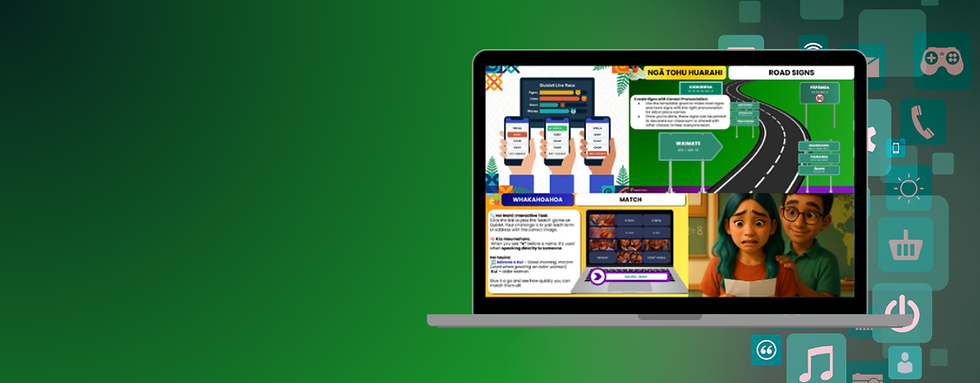
Who doesn’t love Uber Eats and ordering takeaways? In this lively unit, ākonga explore the language of food, choice, and everyday conversations through the world of ordering and sharing kai. Students use te reo Māori to order meals, compare favourites, describe flavours, and talk about the quality, quantity, and cost of food.
Through fun role-plays, takeaway menus, and interactive challenges, learners practise requesting, offering, accepting, and declining things in natural conversation. This engaging unit brings real-life reo Māori into the world of food, fun, and everyday experiences

Whāinga Paetae
Achievement Objectives
At Levels 3 and 4 of the New Zealand Curriculum, ākonga extend their communicative competence into a wider range of familiar, everyday contexts.
In this unit, learners discuss events and where they take place, describe recent activities, share plans for the near future, and communicate about quality, quantity, and cost.
These Achievement Objectives guide learning within Whakangahautia Te Reo and align with Te Tupuranga – Developing Communication Skills in Te Reo Māori.
🌱 LEVEL 3
3.1 communicate, including comparing and contrasting, about habits, routines and customs
3.3 give and follow directions
🌱 LEVEL 4
4.1 request, offer, accept, and decline things, invitations and suggestions
4.5 communicate about the quality, quantity and cost of things.
Putanga Ako
Learning Outcomes
The learning outcomes describe what ākonga will be able to demonstrate by the end of the unit. They focus on communicative competence, cultural participation, confidence, and relational growth, ensuring learning extends beyond language recall to meaningful application.
By the end of this unit, ākonga will be able to demonstrate the following skills:
By the end of this unit, ākonga will be able to use te reo Māori confidently in everyday food and social situations involving ordering, describing, requesting, and discussing kai.
Learners will strengthen their understanding of conversational conventions, politeness, and the role kai plays in bringing people together while developing vocabulary and sentence structures related to food, quantities, prices, preferences, and descriptive language.
Through collaborative and interactive learning experiences, ākonga will use kīwaha, connectors, and conversational reo to communicate naturally and confidently in practical contexts.
The unit also supports oral fluency, listening comprehension, confidence, humour, and social interaction while encouraging learners to see te reo Māori as a living language that belongs in everyday life.
Aromatawai
Assessments
This unit includes a feature-style recorded presentation assessment designed to be engaging, achievable, and confidence-building. Learning is scaffolded to ensure ākonga absorb language meaningfully before producing it through expressive tasks.
Aligned with NZC Levels 3–4 and the Pou Reo framework — Kia Tika, Kia Rere, Kia Māori, and Kia Ora te Reo — assessment prioritises clarity, fluency, cultural integrity, and learner wellbeing. The focus is on authentic communication rather than technical perfection, encouraging courageous and enthusiastic reo use.
Ākonga will participate in a real-world kai ordering challenge where they plan, script, and perform authentic food-ordering scenarios using te reo Māori.
Learners will work collaboratively to create conversations involving greetings, ordering food, asking questions about cost and quantity, expressing preferences, and responding naturally using conversational reo and kīwaha.
They will present or record their scenarios with clear pronunciation, expressive tone, and confident delivery while incorporating creativity, humour, and real-life communication skills.
The unit also includes opportunities for authentic real-world application through takeaway role-plays, class dining experiences, or optional reo Māori ordering experiences within local food settings.
Ngā Hua o Roto
What's Included
Within this unit you will have everything you need to confidently deliver a high-quality, engaging te reo Māori unit - thoughtfully designed to reduce planning time while strengthening learning outcomes.
Each component is structured, practical, and aligned to curriculum expectations, ensuring clarity for kaiako and meaningful progression for ākonga.
📋 MĀHERE AKO – FULL UNIT PLAN
A complete ready-to-teach unit plan including curriculum links, learning intentions, teaching approaches, and clear progression aligned to NZC Levels 3–4.
📚 LESSON SLIDES AND SEQUENCING
Structured lesson sequencing with ready-to-use teaching slides, facilitation guidance, interactive tasks, and authentic everyday learning experiences linked to kai, conversation, and social interaction.
🎯 INTEGRATED LANGUAGE MODES
Engaging activities that strengthen speaking, listening, reading, writing, viewing, and presenting through role-play, games, collaborative kōrero, food-based challenges, and interactive communication tasks.
🍔 REAL-WORLD KAI & CONVERSATION EXPERIENCES
Practical learning opportunities that encourage ākonga to use te reo Māori naturally through takeaway ordering, café role-plays, food reviews, menus, class dining experiences, and conversational challenges.
📝 ĀKONGA EVALUATION & FEEDBACK
Formative reflection tools, learner feedback activities, and assessment support materials that track progress, strengthen confidence, and support future learning.
🌿 KĪWAHA, SOCIAL REO & CULTURAL CONNECTIONS
Authentic kaupapa Māori learning experiences that strengthen conversational reo, humour, manaakitanga, and confidence through meaningful social interaction and shared experiences around kai.
tonoa mai
How to Order


Browse the catalogue
Browse our catalogue to explore the available themes, levels, grammar progressions, and programme durations to find the options that best suit your needs.
.png)
Complete Order
Complete the Te Reo Māori Unit Order form and select the units you would like to order.
.png)
Confirmation & Invoice
Once your form has been submitted, our team will contact you to confirm your request alongside an invoice.
.png)
Sharing & Access
After your order has been confirmed, your requested units will be created and uploaded into a shared digital folder for you and your team to access.